Discovering Exoplanets
How do we find planets orbiting stars other than our Sun?
What Is an Exoplanet?
Our Sun is orbited by a number of planets, all with similar yet different compositions: rocky, gaseous, airless, hot, cold. But are planets outside our solar system similar to those of our own?
In Short…
We always believed there were other planets around other stars. Today, we know there are. In our solar system, every planet orbits the Sun. Extrasolar planets — exoplanets — are planets that orbit a star outside our solar system. There are so many stars out there, many of which are able to host orbiting planets, just as our Sun does.

What Do Exoplanets Look Like?
There is a much greater diversity of exoplanets than of the planets in our own solar system. Exoplanets are made of elements similar to our solar system's planets, such as iron and carbon, but their mixes differ. Hot Jupiters — hot, massive, Jupiter-like planets — are the easiest to find, since their close, fast orbits make them easier to detect. But finding other kinds of planets is no easy task.
The first official exoplanet was discovered in 1988 by a Canadian research team
Well, almost. Though detected in 1988, gamma Cephei A b was officially confirmed as an exoplanet years later, in 2002. At the time, exoplanet search wasn't a priority research area, and detection techniques were still being refined.
To track stellar motion as a way to detect exoplanets, the research team — Gordon Walker, Bruce Campbell, and Stephenson Yang — devised a new detection method called radial velocity. By tracking stellar "wobble," they aimed to determine whether a star was hosting a planet. Their measurements showed gamma Cephei had a periodic 2.5-year wobble, but at the time it was difficult to tell whether this was caused by an orbiting planet or by ordinary stellar activity. Then came the discovery of 51 Pegasi b, announced in 1995 by Michel Mayor and Didier Queloz of the Geneva Observatory.
To this day, exoplanet hunters still disagree over who made the first discovery, as both American and European teams claim priority. The radial velocity method has since been largely replaced by a more precise method: the transit method.
Exoplanets are more common than stars in the Milky Way
Since the 1980s, detection methods have evolved rapidly. Space missions such as Kepler established that exoplanets are abundant — there are some 100–400 billion stars in our galaxy, and there may be as many, or more, planets orbiting them. There may also be many free-floating "rogue" planets not bound to any star yet to be discovered; the upcoming Nancy Grace Roman Space Telescope should find hundreds or more of these.
The number of confirmed exoplanets has exploded since 2016, with the most recent years bringing the greatest hauls yet.
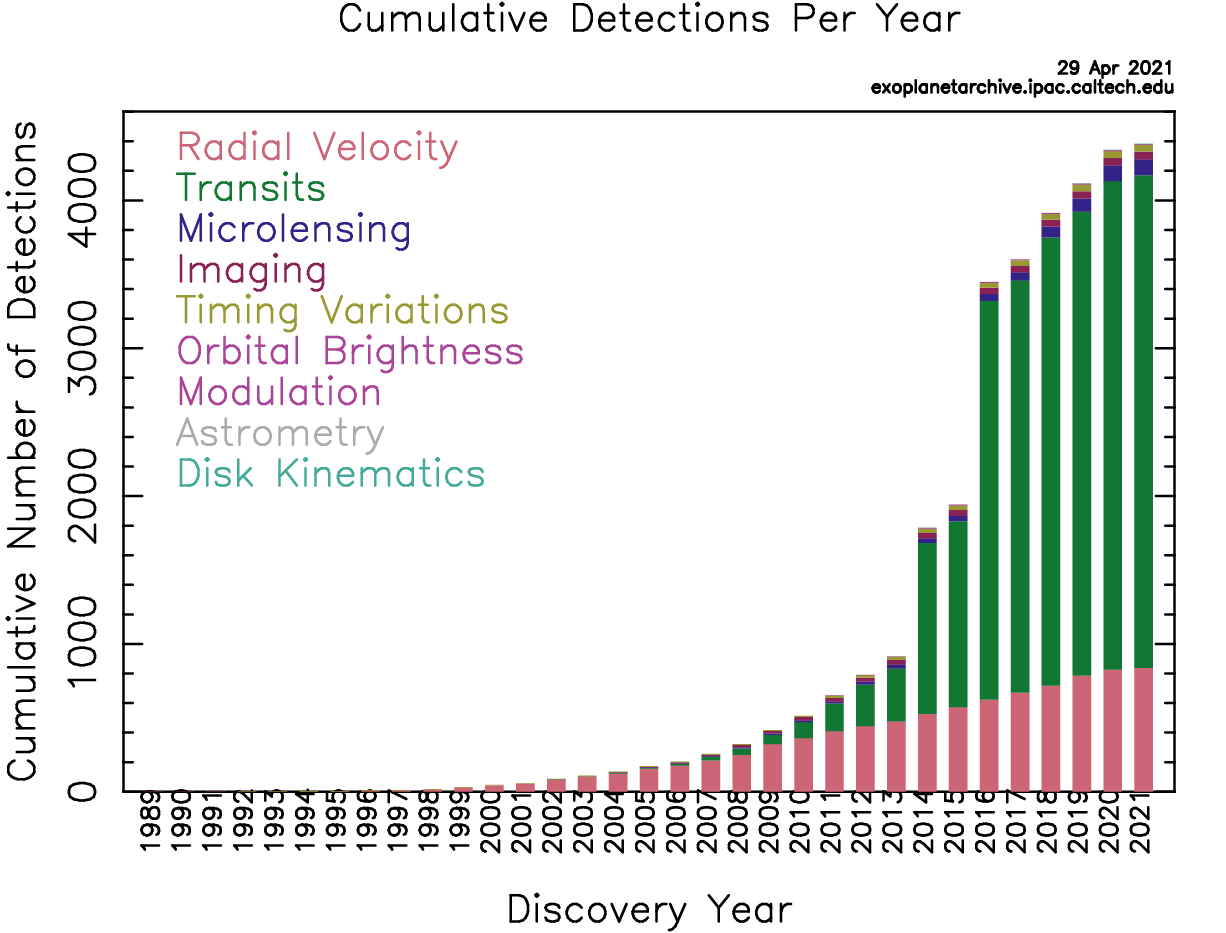
This is why POET is on a mission!
Understanding the formation, internal structure, atmosphere, and evolution of exoplanets is important not only to investigate distant planetary systems, but also to understand the formation and evolution of our own solar system.
What Is a Star?

We generally associate stars with the night sky, yet the daylight we enjoy here on Earth comes from a star that shines bright, day in and day out — our Sun.
From Dust to Star
All stars form from collapsing clouds of gas and dust, known as giant molecular clouds. These clouds can become gravitationally unstable and begin to fragment and collapse — a process that can take millions of years, ending in a new cluster of young stars. These young stars form protoplanetary disks that coalesce into planetary systems. Eventually the cluster dissipates, populating the galaxy with new stars and planets.
A young cluster contains stars of varying mass, with low-mass stars the most common. Low-mass stars, or M-dwarfs, are also the dimmest and coolest — the average M-dwarf puts out only 10% of the Sun's total energy. Some stars are of such low mass that the temperature and pressure at their centre is insufficient for nuclear fusion — the hydrogen-to-helium fusion that makes a star like the Sun shine. These are known as brown dwarfs: objects with 10–100× the mass of Jupiter, still less than 10% the mass of the Sun.
POET's Target Stars
Brown dwarfs are protostars that never gained enough mass during formation to reach the temperatures needed for hydrogen fusion. Both brown dwarfs and very low-mass stars are of particular interest for POET: their temperatures are relatively cool.

How a star's temperature predicts its habitable zone
Earth's primary energy source is light from the Sun. If Earth were much closer to the Sun, the energy received would increase drastically, making our world uninhabitable; much farther away, and our atmosphere would freeze. The distance range at which Earth can maintain its atmosphere and allow liquid water to exist is called the habitable zone. Its position and width depend on the properties of both the host star and the planet.
Low-mass stars are intrinsically faint, emitting less than 10% of the Sun's light. For an Earth-like planet to be habitable around a low-mass star, it must orbit much closer to its host star.
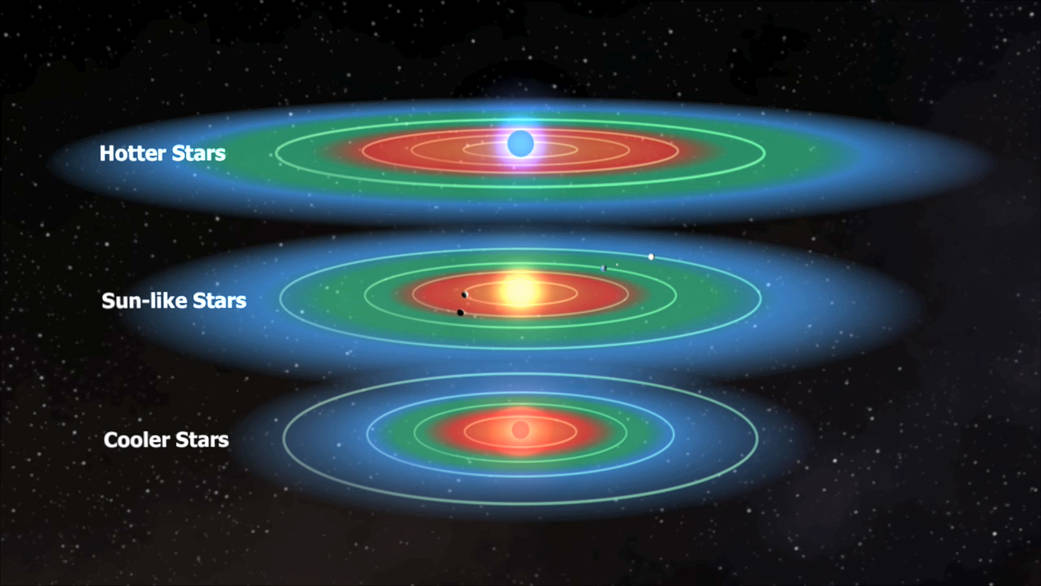
This diagram shows the relationship between a star's temperature and the size and location of its habitable zone (shown in green). The habitable zone around hotter stars is wider and farther out; around cooler stars it is narrower and closer in.
Searching for the habitable zone around cooler stars
POET will search for habitable-zone planets around cool stars — specifically, for potentially rocky and habitable exoplanets via the transit method around very low-mass stars and brown dwarfs.
What Is the Habitable Zone?
What Makes a Planet Potentially Habitable?
The standard definition of a habitable planet is one that can sustain life for a significant period of time. But for life to be sustained, certain conditions need to be present.

The Perfect Distance From Its Star
Not too hot, not too cold — that's the sweet spot for life. The habitable zone is the region around a star where liquid surface water can exist on a planet like Earth. Because brown dwarfs and very low-mass stars are cool, liquid water could exist on planets orbiting much closer to them than is possible in our own solar system — without evaporating.
How Do Cool Stars Generate Heat?
High-mass stars burn hydrogen, a process that generates both heat and visible light. But low-mass stars, far cooler than the Sun, emit most of their light in the infrared — think of a hot piece of metal radiating heat without glowing visibly. To detect this invisible light, POET's microsatellite will carry an infrared filter, enabling transit searches for potentially habitable planets around these cool stars.
Short Orbits for "Easier" Detection
Planets in the habitable zone around very low-mass stars have short orbital periods — 10 days or less — so observing multiple transits takes little time, and the higher transit probability makes them easier to detect than habitable-zone planets around higher-mass stars. If a planet has a 3-day orbit, POET can observe it 10+ times, gaining substantial information within 30 days. A habitable-zone planet around a Sun-like star, with a 365-day orbit, would take 10 years of continuous observation to record the same number of transits.
Why the TRAPPIST-1 discovery is promising for our mission
Remember the TRAPPIST-1 system discovery, back in 2017? TRAPPIST-1 is an ultra-cool red dwarf — a protostar larger than a brown dwarf but much cooler than our Sun — hosting at least seven rocky planets, the most numerous system detected so far. The system is remarkably compact: every planet orbits closer in than Mercury does around our Sun. Three to six of the discovered planets sit in the habitable zone, making TRAPPIST-1 the best target yet for studying the atmospheres of potentially habitable, Earth-size worlds.
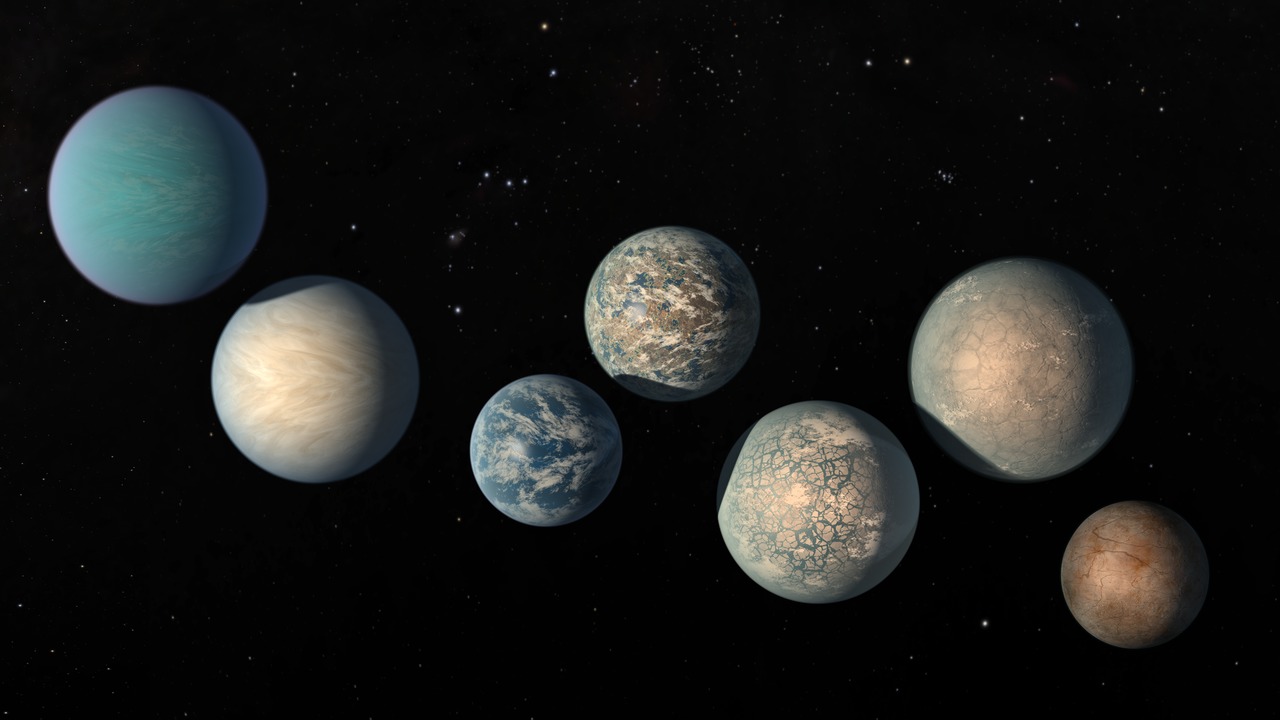
The illustration shows the seven Earth-size planets orbiting TRAPPIST-1 (not to scale) and a range of how they might actually appear. This discovery gives us a good idea of how habitable-zone planets around cooler stars can be detected — and how POET will aim to do the same.
The search for Earth-like conditions
By targeting the habitable zones of low-mass stars over a two-year period, POET will be able to produce an outsized yield of rocky, habitable-zone exoplanets.
Once POET discovers an exoplanet, its atmosphere — if it has one — will need to be characterized to learn its chemical composition.