The Mission
Photometric Observations of Exoplanet Transits (POET)
A Canadian Mission to Discover Habitable-Zone Planets
As we enter the era of extrasolar astrobiology, a Canadian mission to discover habitable-zone planets and characterize their atmospheres is well timed. Space is a Canadian priority, and a micro-satellite with a prime mission to study extrasolar planets aligns with priorities identified by the Canadian astronomy community's Long Range Plan and the Canadian Space Exploration Workshop (CSEW 2016).
Canada is an established leader in micro-satellite technology. Our mission builds on this proud history to push innovation in our exploration of distant worlds. The proposed two-year mission will:
- Equip youth to excel in the jobs of the future by providing hands-on experience with a Canadian-led mission.
- Help build and retain a workforce capable of contributing to next-generation Canadian flagship missions.
- Provide 25% open time for Canadians and maintain an Open Data access policy.
The mission is a university-PI-led, co-funded mission.
The Baseline Mission
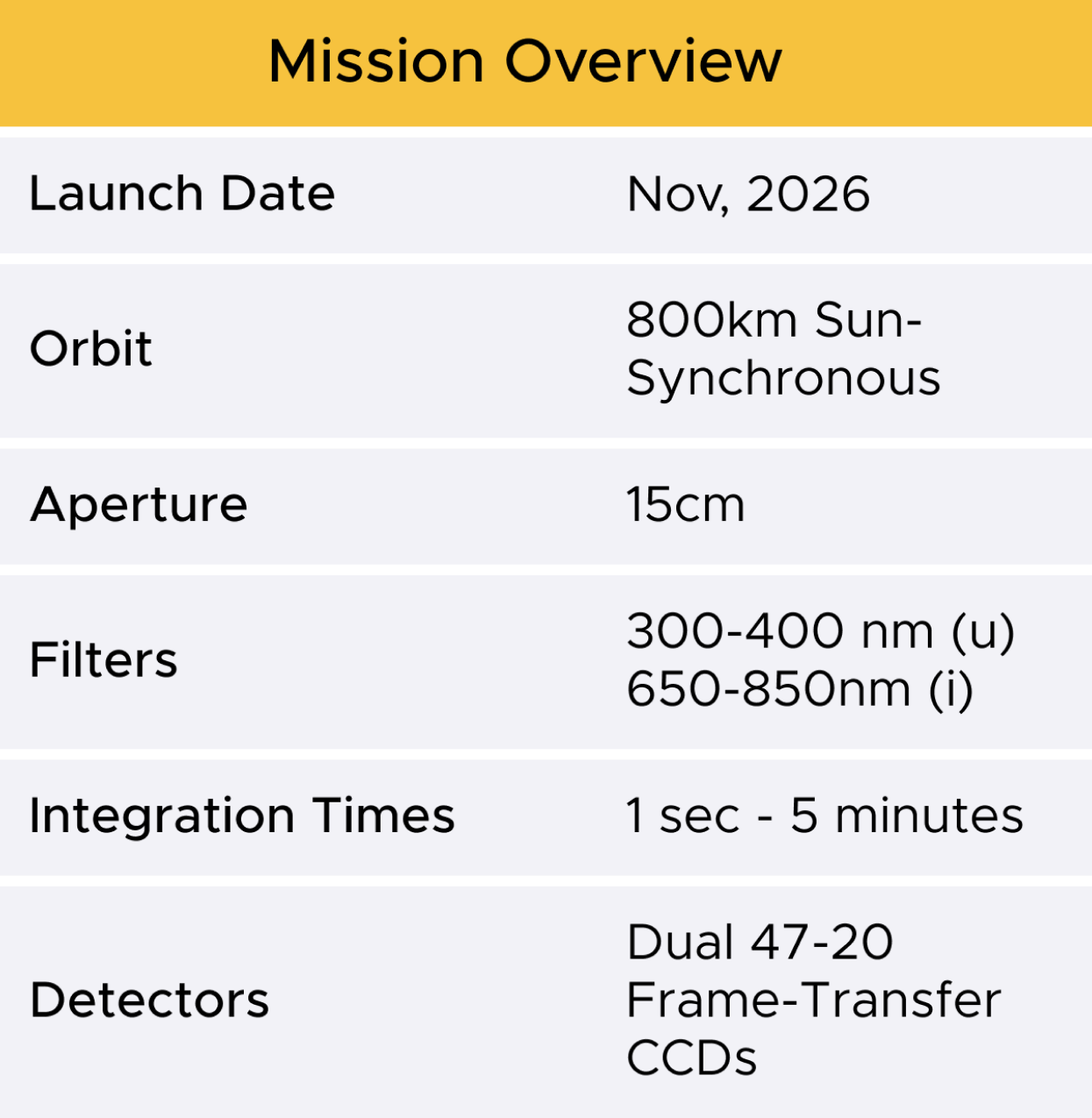
POET is a 20 cm space telescope aboard a micro-satellite in an 800 km Sun-synchronous orbit. The telescope feeds dual CCD detectors to create a highly efficient photometer, used alternately for science and guidance imaging depending on whether u-band or i-band photometry has priority.
The spacecraft's continuous viewing zone (CVZ) spans roughly −20° to +30° declination, with the ability to stare at a single field for up to two months. A minimum mission life of two years is required to reach the mission's science goals.
Science Objectives
The science objective of the Photometric Observations of Exoplanet Transits (POET) mission is the characterization and discovery of extrasolar planets. Planets will be characterized by measuring the change in apparent exoplanet radius as a function of wavelength — a technique known as transit spectroscopy.
Our goal is to measure u-band photometric transits to characterize Rayleigh scattering on 30 known extrasolar planets. Combined u-band/i-band transit photometry will improve exoplanet fundamental parameters and establish legacy, long-term precision timing of transit events. The discovery program will use high-cadence, precision i-band photometry to detect small, potentially rocky and habitable exoplanets via the transit method around very low-mass and brown-dwarf stars.
The mission also carries important ancillary science goals in stellar astrophysics that take advantage of its unique observational capabilities.